Keynote Speakers

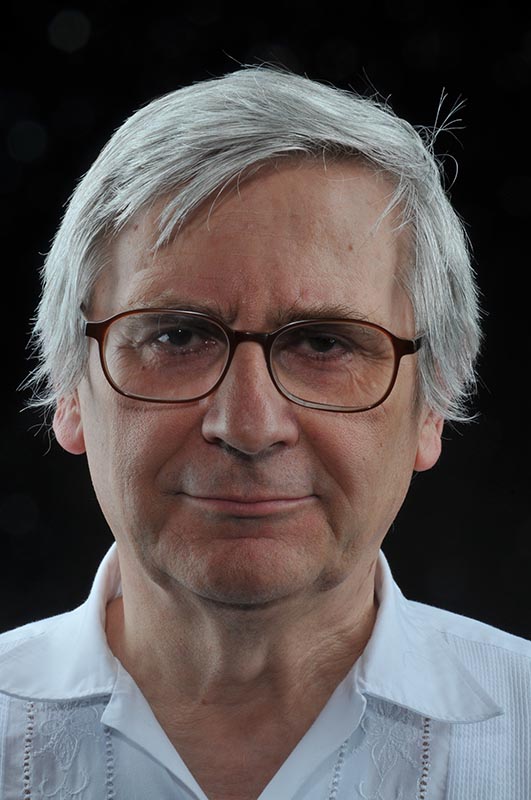
André Helbo

André Helbo is Professor Emeritus of semiotics at the Université Libre de Bruxelles (ULB), where he founded the Erasmus Mundus program in Performance Arts Studies. His main areas of research are general semiotics, performance arts and multi/inter-medial semiotics.  He has published widely in these areas, notably with foundational books in the discipline (Sémiologie de la representation, Le champ sémiologique, Approaching Theatre) and is currently working on a semiotic approach of production/ reception paradigms in the intermedial/ postdigital culture. He edits the international journal of semiotics Degrés (founded in 1973, 210 issues published to date), which has played a decisive role in the history of semiotics, insofar as it has accompanied and sometimes spurred ongoing research.
Helbo is a member of the Royal Academy of Belgium where he regularly organizes symposia on semiotics within the framework of the “Collège Belgique”. He is owner of the Francqui Chair and has been visiting professor in several universities, a.o. in Canada, Denmark, France, Germany, Italy, North Africa, Spain, South Korea, Turkey, etc.

In 1975 Eco highlighted that the semiotic property of spectacle is to show, or” ostend”, real objects as signs. The main question at that time was to feature what may be peculiar about spectacle compared to other forms of art. In this aspect, theatre, opera, dance differ from literature, where words are artificial signs produced by man to communicate (Eco, 1977). It also differs from the visual arts, and even from cinema, in as far as film is only a reflection of real presence.
Theater, dance, circus and opera are regarded by semiotics as hypermedia. Faced with enactment, semiotics of spectacle has developed specific methodologies (a “territorial” semiotics) by asking a question all history seems to bear witness to, namely the nature of expert knowledge confronted with a polymorphic, complex, and unstable object. In this sense the performative turn of spectacle semiotics is in fact linked to the syncretic dimension of the spectacle. As a “totalizing” semiotic practice (Ubersfeld 1977), or a “polyphony” (Barthes 1964), a performance combines, among others, verbal and nonverbal signs, a “dynamics of meaning” (Prague School), temporal/spatial articulation patterns and mediation processes.
Nowadays, the development of theories of meaning in motion gives rise to new questions regarding bios, collective enunciation, and, among others, intersemiotic translation, multimodality, spectacularity, authoriality and acting. These questions gain a special relevance in the digital and postdigital environments, which formalize “reality” through technological (and among others AI) devices. By expanding concepts that were once considered unique to human agents —such as reasoning and creativity —to include among others what “phenomenotechnical systems” (Bachelard) offer, (post)digital productions are paving the way for the recognition of semiosis in non-human systems and living beings.
In the postdigital culture, the indeterminacy of signs becomes the norm: indeterminacy of post-biological bodily states, cross-fertilization between the biological body and technology. Postdigitality involves questioning the blurred boundaries between the real and the virtual. It addresses semiosis within hybrid and interconnected ecosystems: the analog/digital binary is no longer operational. In this context, semiotics is called upon to rethink its categories in the face of landscapes populated by human and non-human entities. One of the consequences for the semiotic approach of spectacle is the necessity to explore the “register” of presence—that is, the multiple “variations of being-there” on stage—from a semio-systemic perspective that highlights the dialectic relationship between the processes of (not-) acting and the actor/spectator’s corporeality/environment.

Patrice Pavis

Patrice Pavis has been Professor at the Université de Paris 3 et Paris 8, as well as at the University of Kent, at different German universities and at the Korea National University of the Arts. Honorary fellow of the University of London, Honoris causa (Bratislava, Sofia, Targu Mures, Skopje). Last publications: Contemporary Mise en scène, Routledge, 2013 ; Routledge Dictionary of performance and contemporary theatre, Routledge, 2016); Performing Korea, Palgrave (2016), Let’s embrace in the Cherry Orchard, (Theatre), Universidad autonoma de Chihuahua, 2014; A Visit to the Hospital, (Theatre), 2017 Dictionnaire du théâtre, 4th edition, Armand Colin, 2019. Poème toi-même. Novel (2021). Last publications: Contemporary Mise en scène, Routledge, 2013 ; Routledge Dictionary of performance and contemporary theatre, Routledge, 2016); Performing Korea, Palgrave (2016), Let’s embrace in the Cherry Orchard, (Theatre), Universidad autonoma de Chihuahua, 2014; A Visit to the Hospital, (Theatre), 2017 Dictionnaire du théâtre, 4th edition, Armand Colin, 2019. Poème toi-même. Novel (2021)

The conference on semiotics and performance gives us the opportunity to check if there is a performative turn, and in what respect. Using the practice of adaptation (mainly from a text into another text or into a theatre production), this presentation aims at comparing the possibilities of semiology and of performance (performative action) when looking for a contemporary (or temporary?) method and theory of adapting texts of all kinds for the stage.